Most vehicles fight physics. We use it.
TandAIRium builds the world’s only vehicles designed to operate consistently in ground effect – from autonomous drones to crewed passenger vehicles.
A scalable maritime operations platform with a modular mission architecture for civilian and defence applications: fast, energy-efficient and independent of conventional runways and aviation infrastructure.
Enter a new dimension of maritime mobility – just above the surface.
About Ground Effect
A pelican flying over the sea wastes no energy.
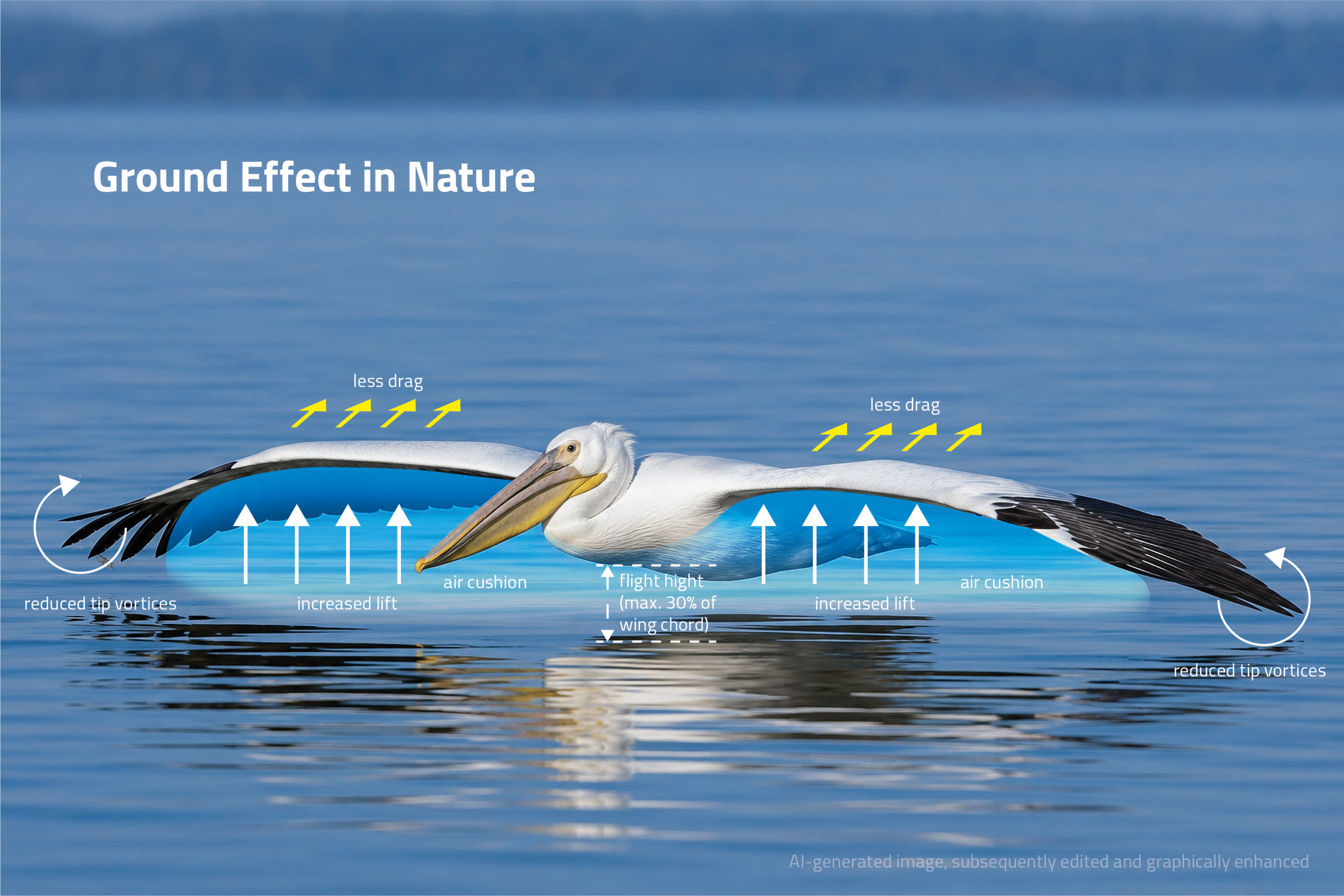
When covering long distances, it glides just above the water’s surface, harnessing the ground effect: wingtip vortices are reduced, drag decreases and lift becomes more efficient.
Nature has been using this principle for millions of years.
More than 60 years ago, German engineer Günther W. Jörg translated it into an extraordinary technical concept: two pairs of wings arranged in tandem, designed to stabilise themselves aerodynamically in ground effect.
While conventional ground-effect vehicles require continuous control to maintain their altitude and attitude above the surface, Jörg took a fundamentally different approach. The interaction between the front and rear wings creates inherent aerodynamic stability.
The result is a vehicle that does not need to constantly compensate for an inherently unstable aerodynamic condition.
It does not fight the physics of ground effect. It works with it.
Today, this principle forms the foundation of a new generation of autonomous maritime platforms.
This is TandAIRium.
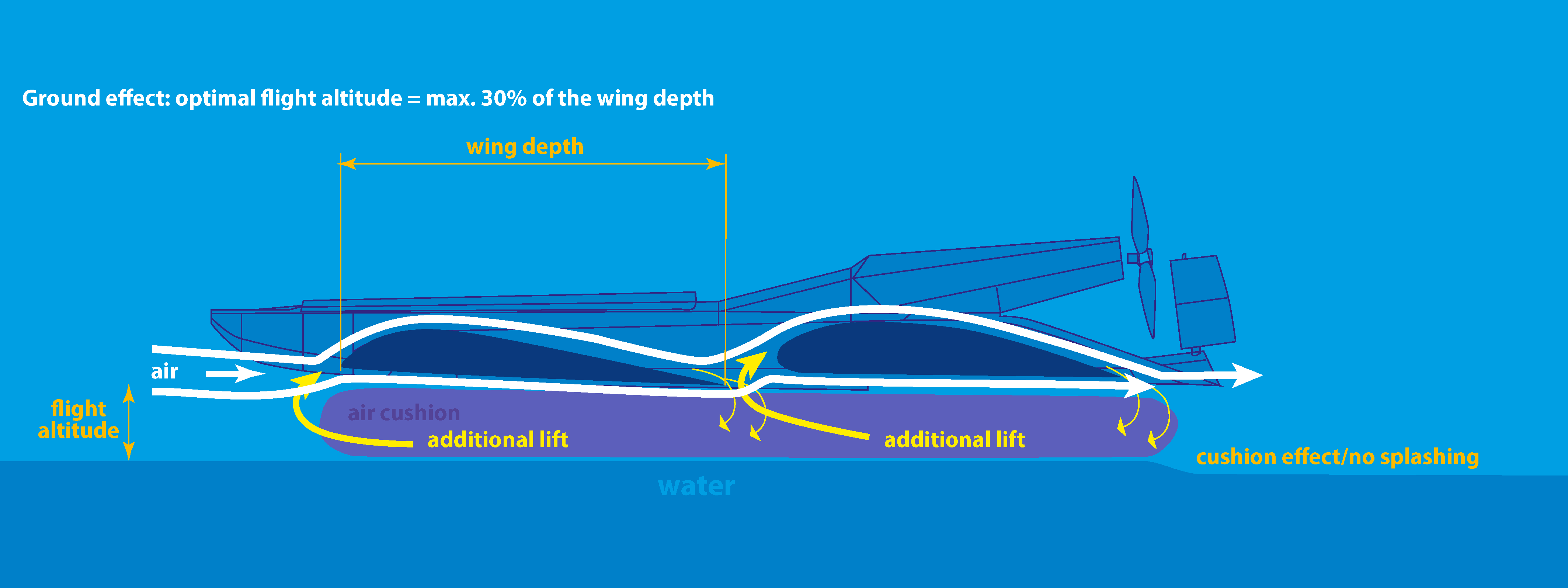
Ground Effect Technology is our DNA
The Mind Behind
Reiner Jörg didn’t discover the tandem-wing principle in a science book. He grew up with it.
He helped build his father Günther W. Jörg’s vehicles, flew them and completed more than 3,000 take-offs and landings – experiencing their capabilities and their limitations first-hand.
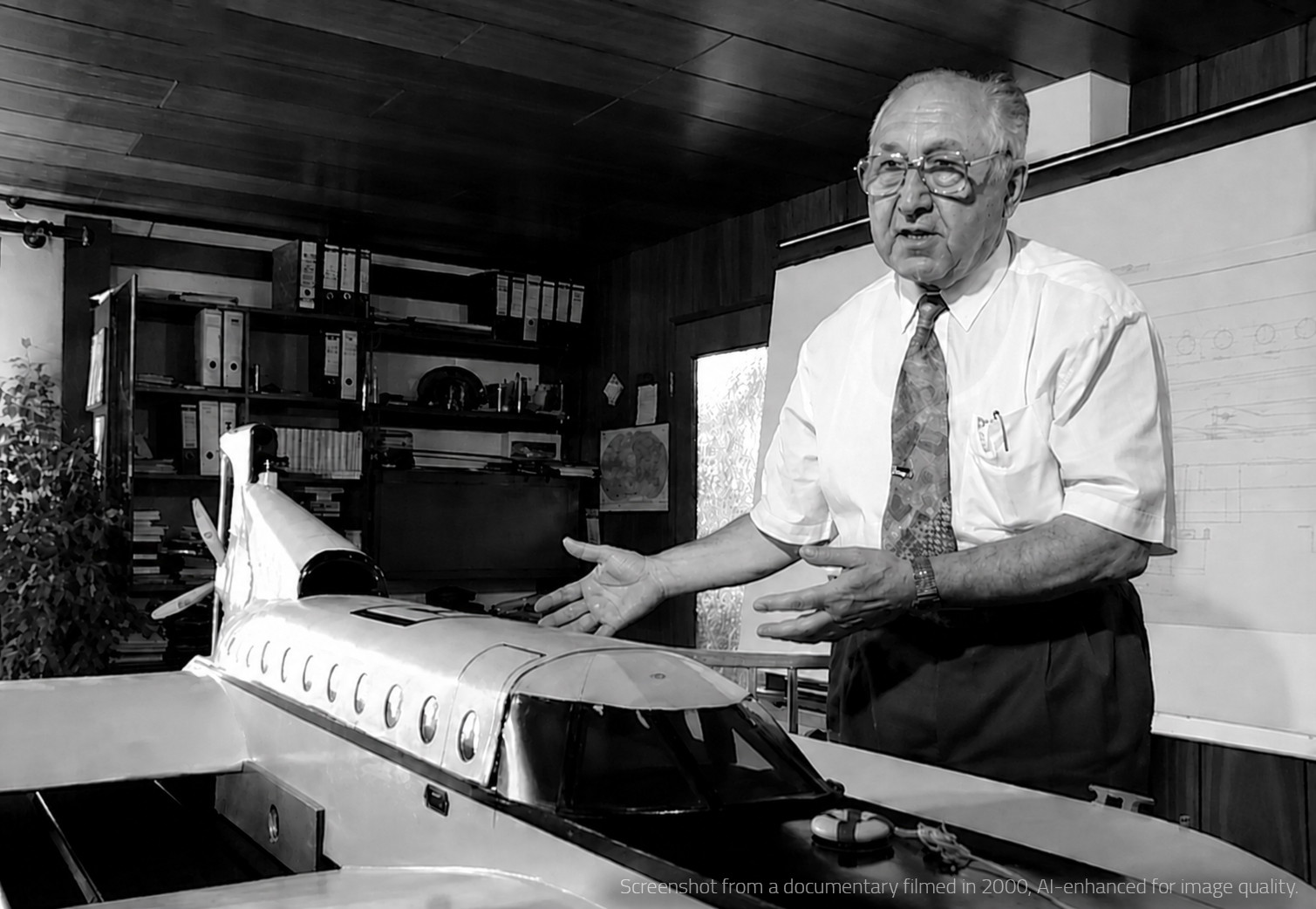
An engineer at heart, Reiner knew exactly where the original concept could be taken further. He fundamentally re-engineered the tandem-wing principle and redesigned the vehicle for a new generation of maritime platforms.
Decades of hands-on experience became engineering knowledge.
Engineering knowledge became TandAIRium.
Reiner Jörg is TandAIRium.
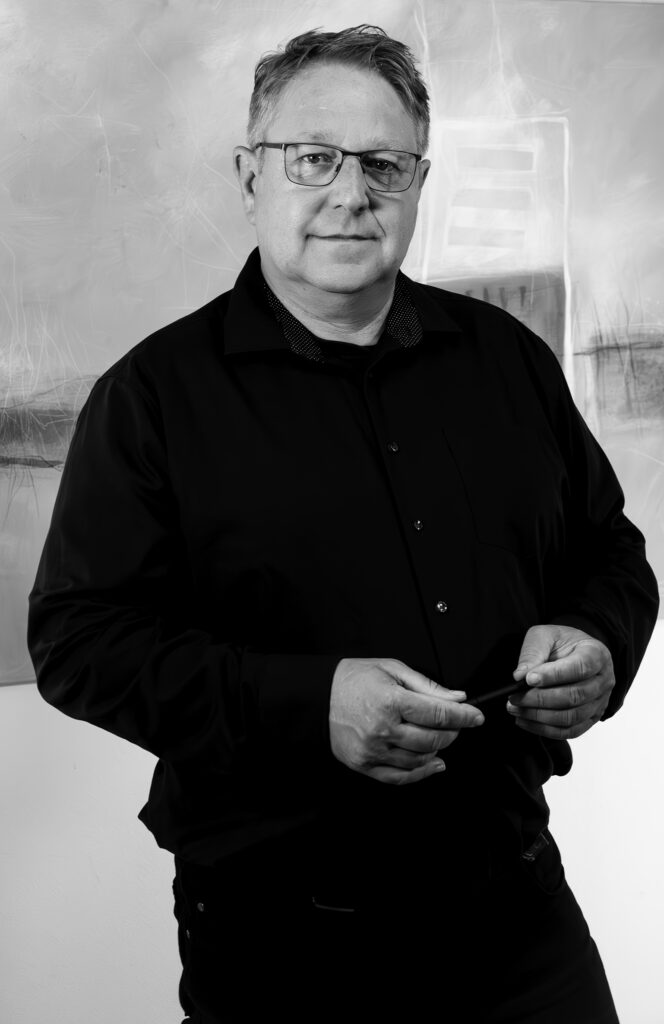
For over 60 years, the ground effect waited in the shadows of aviation. Powerful, proven, yet overlooked. Today, we bring it to life as a new operational platform architecture.
Reiner Jörg | Son of Günther Jörg | CEO and Co-Founder of Tandairium GmbH
TW Series
Discover our range of services for cargo, defense, and passenger transportation.
TW cargo | unmanned
Lightweight. Modular. Mission-ready.
Our unmanned TW Cargo platforms offer an excellent payload-to-weight ratio and can be configured for a wide range of missions, sensors and cargo requirements.
TW defense | mission sets
Configurable for different mission profiles.
Modular payload and sensor integration, combined with very low radar, thermal and acoustic signatures — and no sonar signature in ground-effect flight.
TW seat | passenger
Fast. Efficient. Comfortable.
TW Seat uses ground-effect flight for energy-efficient passenger transport — connecting islands and coastal regions at speed, without the need for runways.
Gallery of TW4 cargo prototype
Explore the world’s first true ground effect drone in action. From early prototypes to live test flights, our gallery offers a glimpse into the design, innovation, and performance behind the TW4 Drone.
From engineering to real-world flight.
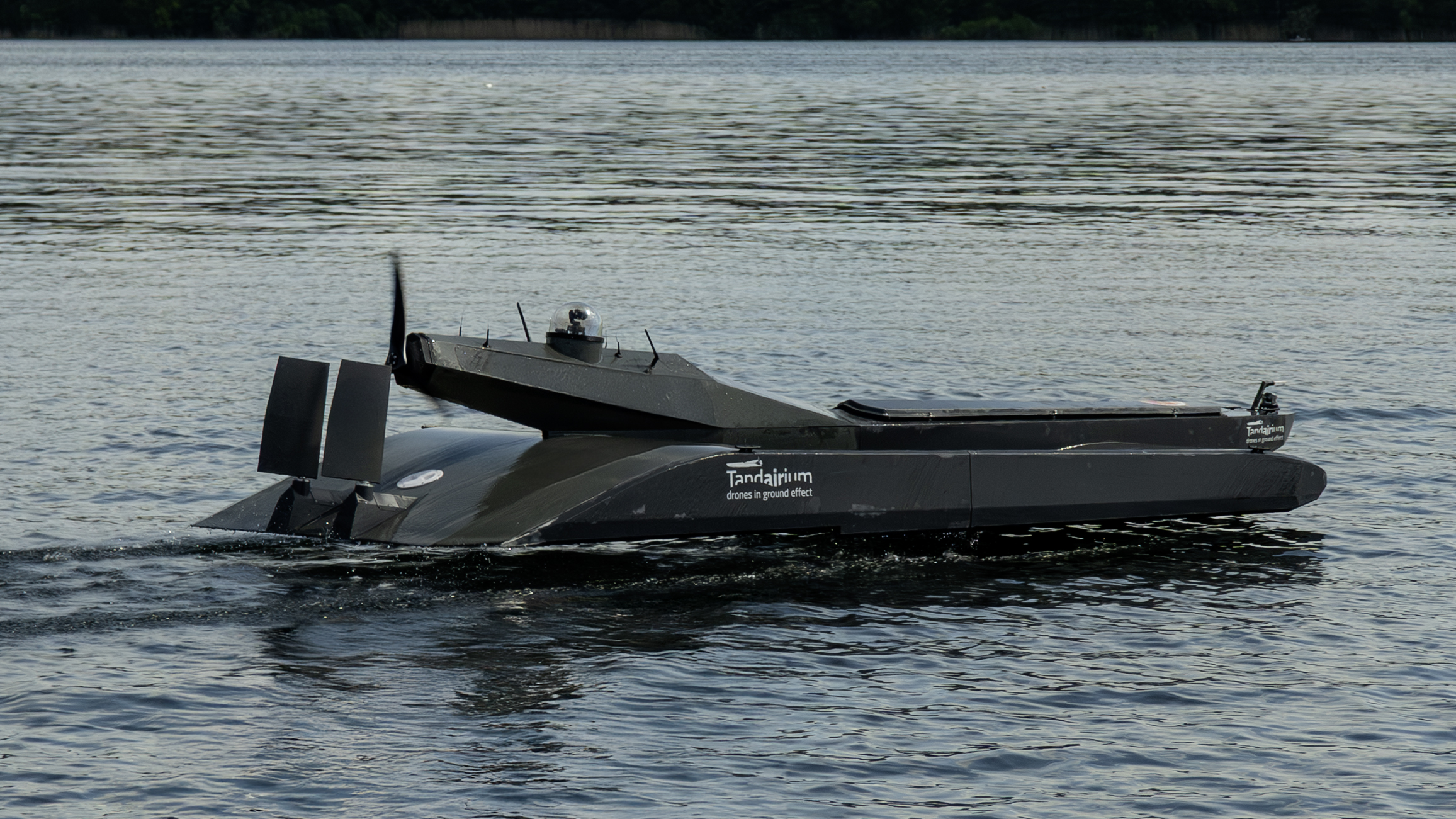
The TW4 Cargo is not a concept or a rendering, but a fully functional prototype that has already completed numerous tests on water and in ground-effect flight. Our gallery shows the vehicle where it matters: in operation — testing, flying and providing real-world experience for the continued development of the TandAIRium platform — just inches above the surface.
Cargo
Successful Prototype and Scalable Platform
Various Mission Sets
The prototype with a length of approximately 4 metres (TW4 Drone) has already been built and successfully tested in real-world flight trials. The TW Cargo Series is a scalable family of unmanned ground-effect vehicles for maritime transport, security, rescue and research.
Its modular architecture allows cargo compartments, cameras, sensors and communication systems to be configured for different missions while retaining the same aerodynamic foundation.
TW4 — Flown Prototype
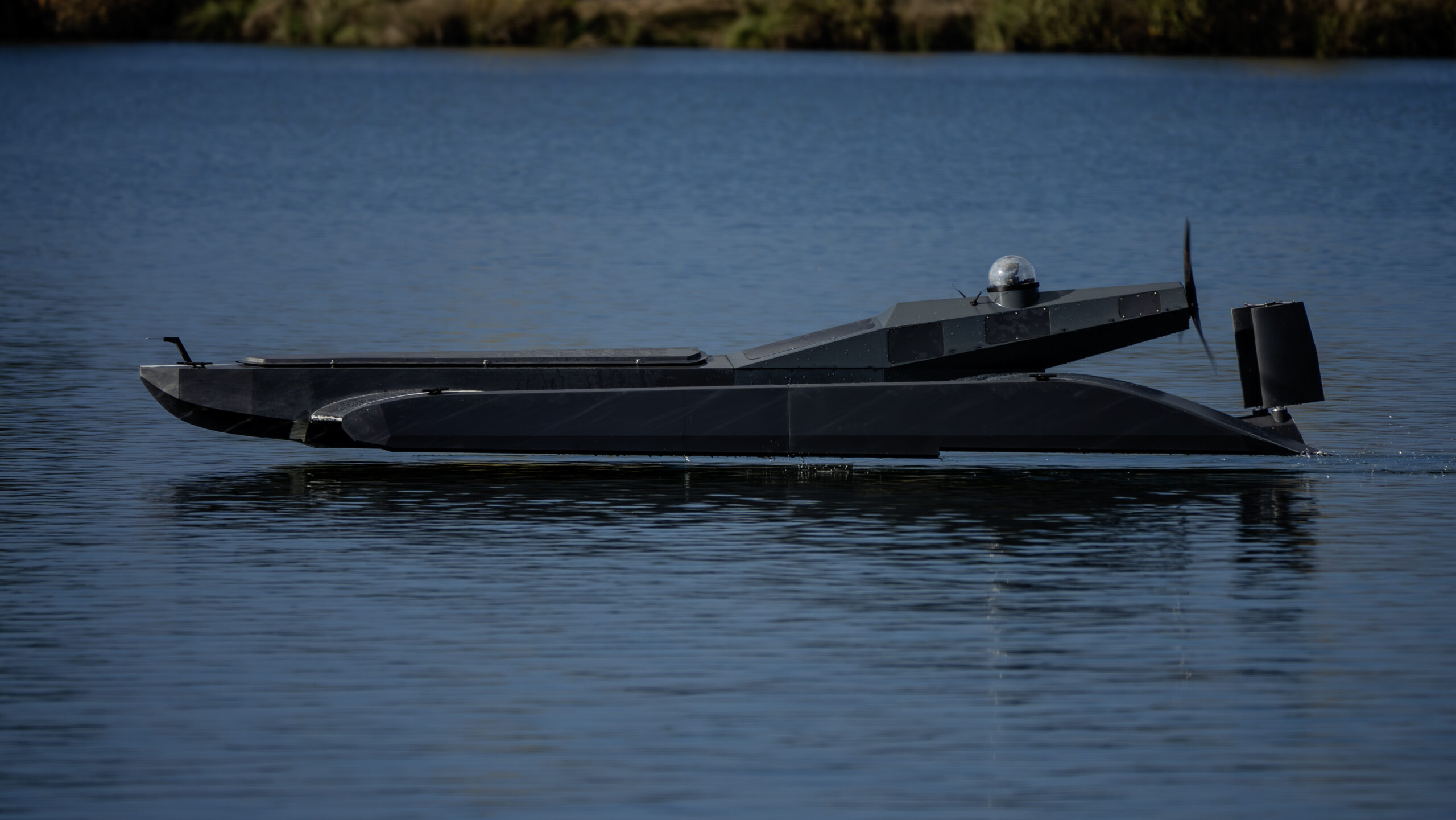
The TW4 has been built, tested and successfully flown. It demonstrates the stability, controllability and payload capability of TandAIRium’s tandem-airfoil technology in ground effect.
4.18 m overall length
1.58 m wingspan
Up to 37 kg payload
Up to 60 km range
8 kW electric propulsion
Modular payload integration
The next development step is a 14-metre platform with increased payload, range and operational capability.
Mission Profiles
Defence & Maritime Security
Reconnaissance, coastal surveillance, sensor deployment, tactical supply and protection of critical infrastructure.
Rescue & Emergency Response
Search operations, live imagery and delivery of flotation devices, medical supplies or communication equipment.
Offshore & Cargo Logistics
Transport of tools, components and urgent supplies between ports, islands, ships and offshore installations.
Critical Infrastructure
Inspection and monitoring of ports, wind farms, platforms, pipelines and subsea cables.
Science & Environmental Monitoring
Coastal mapping, wildlife observation, pollution monitoring and deployment of scientific sensors.
Scalable by Design
TandAIRium does not develop a separate vehicle for every task. Vehicle size, payload and mission systems can be adapted while the tandem-airfoil principle remains the common technological foundation.
From a flown 4-metre prototype to mission-ready platforms at operational scale. Despite its compact dimensions, the prototype has already demonstrated impressive performance, carrying payloads of up to 37 kg with operational ranges reaching 60 km. These figures – achieved with a whisper-quiet 8 kW electric drive – underline the remarkable potential of the platform.
At the same time, the drone is built on a modular architecture: fuselage and wings can be adapted to various payload requirements, and the vehicle can be equipped with cameras, sensor arrays or other mission-specific modules. This scalable platform approach enables the development of future variants in different sizes or specializations – without having to reinvent the basic design. The story of the TW4 Cargo demonstrates one thing clearly: this technology is ready for deployment and can now be scaled for industrial production. What began as a bold idea has rapidly evolved into a tangible high-tech product – a solid foundation for further series development and growth.
Defense
Sovereign Capability for Maritime Missions
Superiority, Speed, Sovereignty – they always prevail!
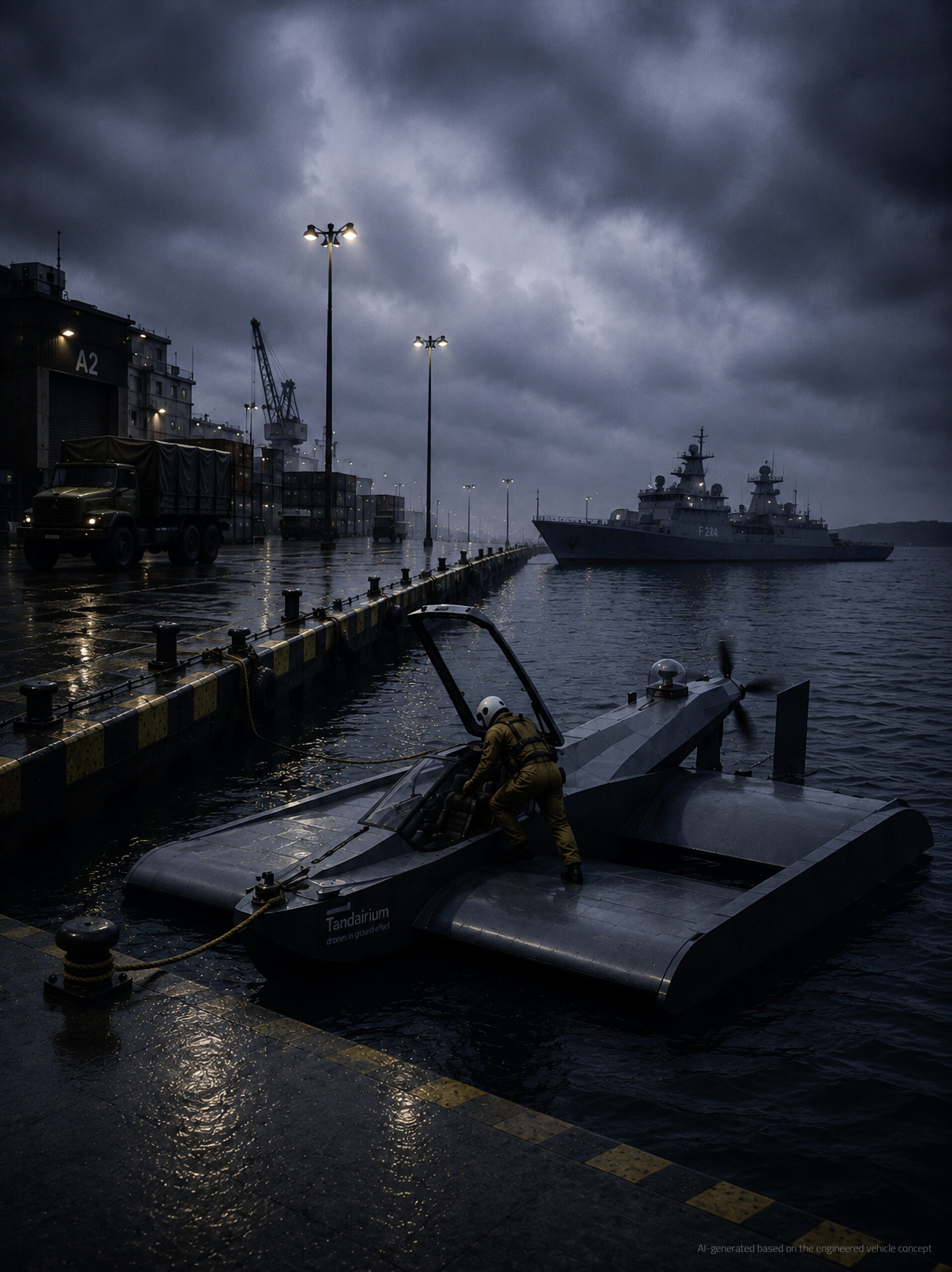
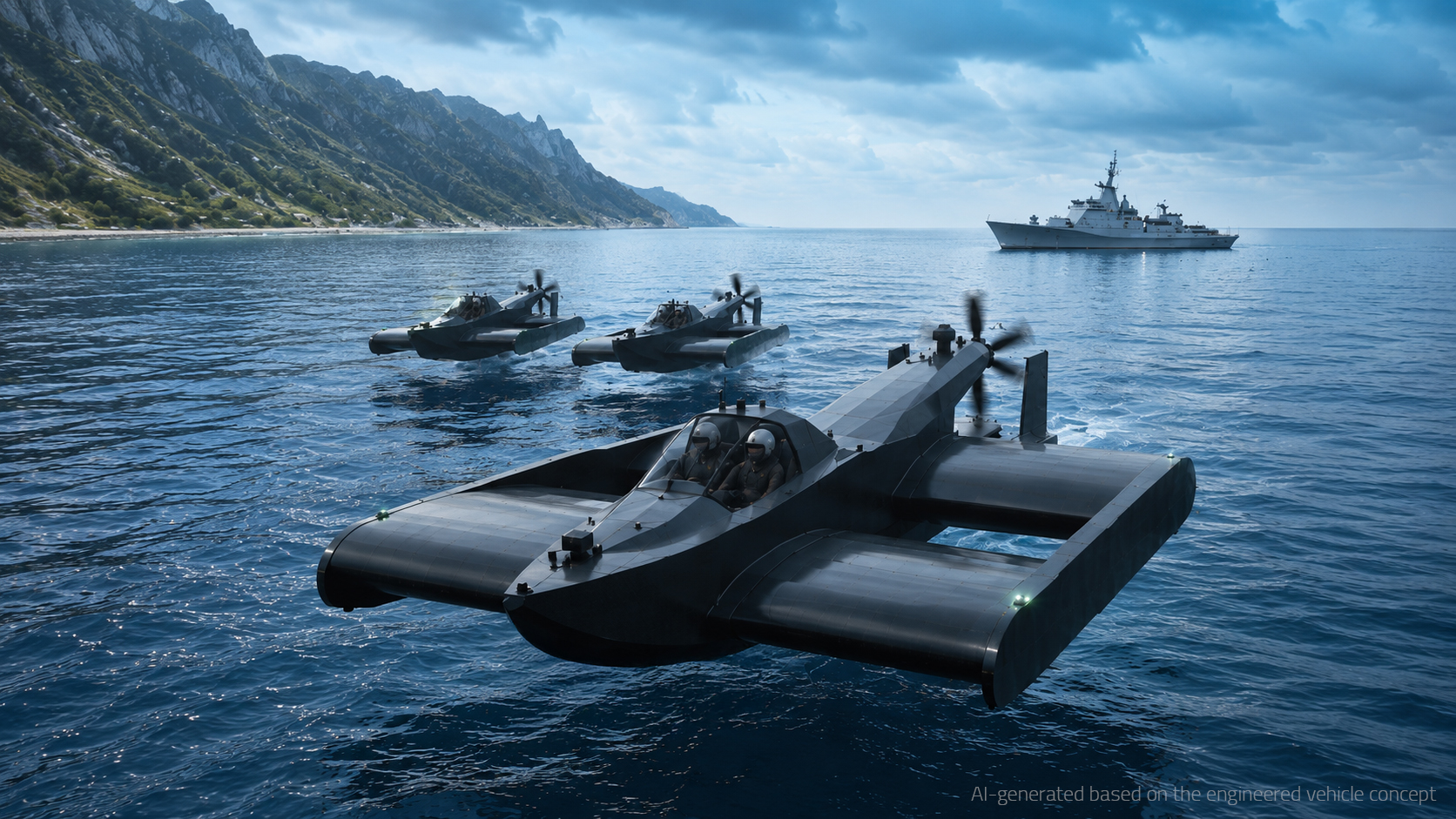
TandAIRium is developing scalable ground-effect vehicles for operations close to the water. The defense platform is available as an uncrewed mission vehicle or as a crewed version for two onboard operators.
Two Platform Configurations
Uncrewed Mission Platform
Based on the TW Cargo architecture and configurable with reconnaissance sensors, cameras, communication systems, cargo or other mission-specific payloads. Designed for remote operations and deployment in high-risk environments without exposing a crew.
Crewed Mission Platform
Configured for two onboard operators plus additional mission payload. Designed for operations requiring direct human assessment, decision-making and specialist equipment at the mission site.
Operational Advantages
Low-level operation close to the surface
Reduced radar, acoustic and thermal signature potential
No underwater propulsion signature during flight
Modular mission-specific payloads
Runway-independent deployment
European expertise and industrial network
Mission Profiles
Maritime reconnaissance and surveillance
Protection of ports, offshore facilities, cables and pipelines
Tactical transport and resupply
Sensor and communication deployment
Search, rescue and governmental operations
Proven Foundation
The flown TW4 prototype demonstrates the aerodynamic principle with up to 37 kg payload, 60 km range and 105 km/h maximum speed.
The next development step is the 14-metre platform, designed for increased payload, range and operational capability.
Radar, thermal and acoustic characteristics will be quantified during platform-specific testing.
Commercial | Civil
Civil Maritime Mobility
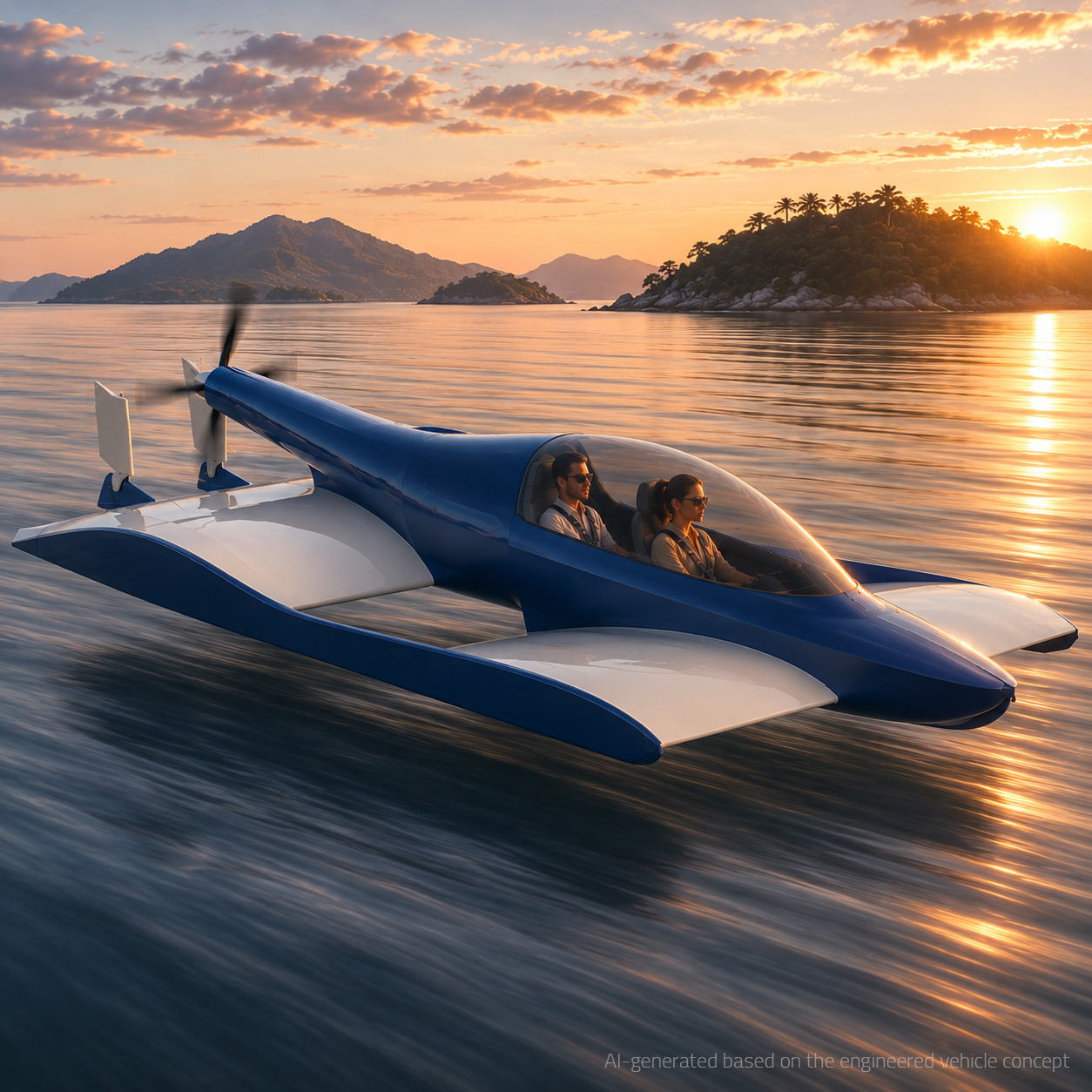
TandAIRium is developing scalable ground-effect vehicles for passenger transport and specialised civil missions — without the need for runways or airport infrastructure.
TWS Seat Series
Designed for certification as Type A WIG craft, the TWS Seats Series operates exclusively within ground effect and is governed by maritime rather than aviation regulations. This allows operation with the appropriate boat licence instead of a pilot’s licence, subject to national requirements.
Key advantages
Maritime rather than aviation operation
No pilot’s licence required
Fast point-to-point connections
Reduced surface contact and wake
Scalable passenger and cargo capacity
Applications
Passenger Transport & Tourism
Coastal routes, island transfers and charter operations.
Offshore & Cargo Logistics
Personnel, equipment and urgent supplies.
Rescue & Public Service
Rapid reconnaissance and operational support.
Science & Environmental Monitoring
Transport of specialists, sensors and sampling equipment.
Investment & Strategic Partnerships
Tandairium is Scaling a Technology That Has Already Flown
TandAIRium is developing a scalable family of unmanned and passenger-carrying ground-effect vehicles.
Our first step was the TW4: a fully functional 4-metre prototype built to demonstrate the tandem-airfoil principle in real operation. It has been constructed, tested and flown.
The next logical step is now the development of a 14-metre vehicle.
This is the stage for which we are seeking investors and strategic partners.
A Bottom-Up Development Strategy
TandAIRium does not begin with the largest and most complex vehicle. We scale the technology progressively from one validated platform size to the next.
Each development stage is designed to generate:
> A new physical and operational proof point
>. Validated aerodynamic and structural data
>. Experience with propulsion, control and maritime operation
>. A foundation for the following vehicle class
>. Clearly defined technical and commercial milestones
This reduces development risk and allows investment to follow measurable progress.
Investors do not have to finance the entire roadmap at once. They participate in a staged programme in which each vehicle generation builds on the knowledge gained from the previous one.
From Prototype to Vehicle Family
TW4 — Flown prototype
The 4-metre platform demonstrates the aerodynamic principle, stability and controllability of the tandem-airfoil configuration in ground effect.
14-metre platform — Next development stage
The next vehicle will validate the technology at operational scale and create the foundation for larger payloads, extended range and mission-specific configurations.
Unmanned platforms — Commercial and dual-use applications
Future configurations are intended for logistics, maritime security, rescue, offshore operations, research and environmental monitoring.
Passenger vehicles — Scalable mobility platform
The same aerodynamic principle forms the basis for future passenger-carrying craft for coastal, inter-island and regional maritime transport.
Unmanned and passenger vehicles are therefore not separate ideas. They are different applications of the same scalable technological platform.
The Next Investable Step
The current investment opportunity is concrete: the engineering, construction and validation of the 14-metre vehicle.
Funding will support:
Detailed engineering and structural development
Aerodynamic and hydrodynamic validation
Propulsion and energy systems
Control and navigation
Prototype construction
Ground-effect and maritime testing
Preparation for mission-specific configurations
Classification and regulatory development
Industrialisation planning
The objective is not to finance a distant final vision in a single leap. It is to reach the next technically decisive milestone — and create measurable value through its successful validation.
One Principle. Successive Scales. Multiple Markets.
The tandem-airfoil principle enables a coherent development path from compact unmanned systems to cargo and passenger vehicles.
This platform approach opens applications in:
Defence and maritime security
Cargo and coastal logistics
Rescue and emergency response
Offshore energy and infrastructure
Scientific and environmental monitoring
Coastal and inter-island passenger transport
Each market becomes accessible at the vehicle size and development stage appropriate to it.
Invest in the Next Step
The aerodynamic principle has already been demonstrated in flight. The next task is to prove its capability at 14-metre scale.
We are looking for investors and strategic partners who share our approach: ambitious in vision, disciplined in development and committed to building a sovereign European maritime technology platform.
Invest in the 14-metre platform
Request the investment brief
Discuss a strategic partnership
Why Now?
Europe’s maritime environment is changing rapidly. Defence readiness is increasing, critical infrastructure requires better protection, offshore activity is expanding, shipping must decarbonise and ocean monitoring is becoming strategically important.
These are not isolated markets. They create overlapping demand for platforms that can move people, payloads and sensors rapidly across water — without runways or conventional aviation infrastructure.
Defence & Maritime Security
EU defence expenditure reached 418 billion € in 2025 and is projected to rise to approximately 454 billion € in 2026. The EU’s Readiness 2030 framework could enable up to 800 billion € in additional defence expenditure by 2030.
Europe needs sovereign capabilities for maritime surveillance, reconnaissance, tactical logistics and the protection of ports, offshore installations, cables and pipelines.
Relevant TandAIRium capabilities
Low-altitude maritime operation
Modular sensor and communication payloads
Coastal surveillance and reconnaissance
Tactical transport and resupply
European development and production
European Defence Agency · European Commission
Sustainable Maritime Mobility
The International Maritime Organization aims to reduce annual greenhouse-gas emissions from international shipping by at least 20% by 2030 and 70% by 2040, compared with 2008, on the path towards net zero by or around 2050.
Ground-effect vehicles offer a new approach to fast maritime transport: they travel above the water and use the aerodynamic cushion created close to the surface.
Potential applications
Coastal and inter-island passenger transport
Time-critical cargo and medical supply
Connections to remote communities
Fast maritime mobility without airport infrastructure
TandAIRium is developing both unmanned platforms and future passenger vehicles around the same scalable aerodynamic principle.
International Maritime Organization
Offshore Infrastructure
EU Member States are targeting approximately 109–112 GW of offshore renewable-energy capacity by 2030, rising to 281–354 GW by 2050.
This growth will create an extensive network of turbines, substations, cables and offshore installations that must be supplied, inspected, monitored and protected.
Potential applications
Urgent delivery of tools and components
Sensor transport and infrastructure inspection
Maintenance and emergency support
Connection between ports and offshore installations
Rescue & Emergency Response
Maritime emergencies demand rapid reconnaissance and the ability to deliver equipment before conventional rescue assets arrive.
Depending on vehicle size and configuration, TandAIRium platforms could support:
Search and situational awareness
Live optical and thermal imagery
Delivery of flotation devices and medical supplies
Temporary communication links
Operations in shallow or remote coastal areas
The vehicles would complement rescue boats and helicopters as an additional operational layer — not replace them.
Science & Ocean Monitoring
Europe is expanding ocean observation and environmental protection. The Horizon Europe Mission “Restore our Ocean and Waters” provides 244 million € for its 2026–2027 calls, while OceanEye is intended to support a fully operational European ocean-observation system by 2030.
Potential applications
Water-quality and pollution monitoring
Wildlife observation
Coastal mapping and surveying
Deployment of scientific sensors
Data collection after storms or spills
European Commission: Mission Ocean · European Commission: OceanEye
One Aerodynamic Principle. Multi Mission Sets.
TandAIRium is not developing a separate vehicle for every application.
Unmanned mission platforms, cargo configurations and passenger vehicles are based on the same scalable tandem-airfoil principle. Payload modules, sensors, communication systems and propulsion configurations can be adapted to different tasks while retaining a common aerodynamic and structural foundation.
This platform strategy allows each new vehicle generation to build on the technical knowledge gained from the previous one.
Why Choose Us
Unique Expertise. Proven Technology. Ready to Scale.
TandAIRium combines decades of first-hand expertise with a technology that has already been built, tested and flown.
As the son of inventor Günther W. Jörg, Reiner Jörg is the principal technical authority behind the tandem-airfoil technology. He has built, piloted and advanced these vehicles himself — preserving practical knowledge that cannot be derived from drawings and calculations alone.
TandAIRium is supported by an established network of engineers, specialists, suppliers and production facilities covering lightweight construction, propulsion, control systems, prototyping and industrialisation.
Developed in Germany and embedded in a European value chain, the platform contributes to technological sovereignty in both civil and security-related markets.
The next investment milestone is clearly defined: scaling the flown 4-metre prototype into a 14-metre operational platform.
We do not scale a promise. We scale a technology that has already flown.
Frequently Asked Questions
Sea State: How do waves affect TandAIRium vehicles?
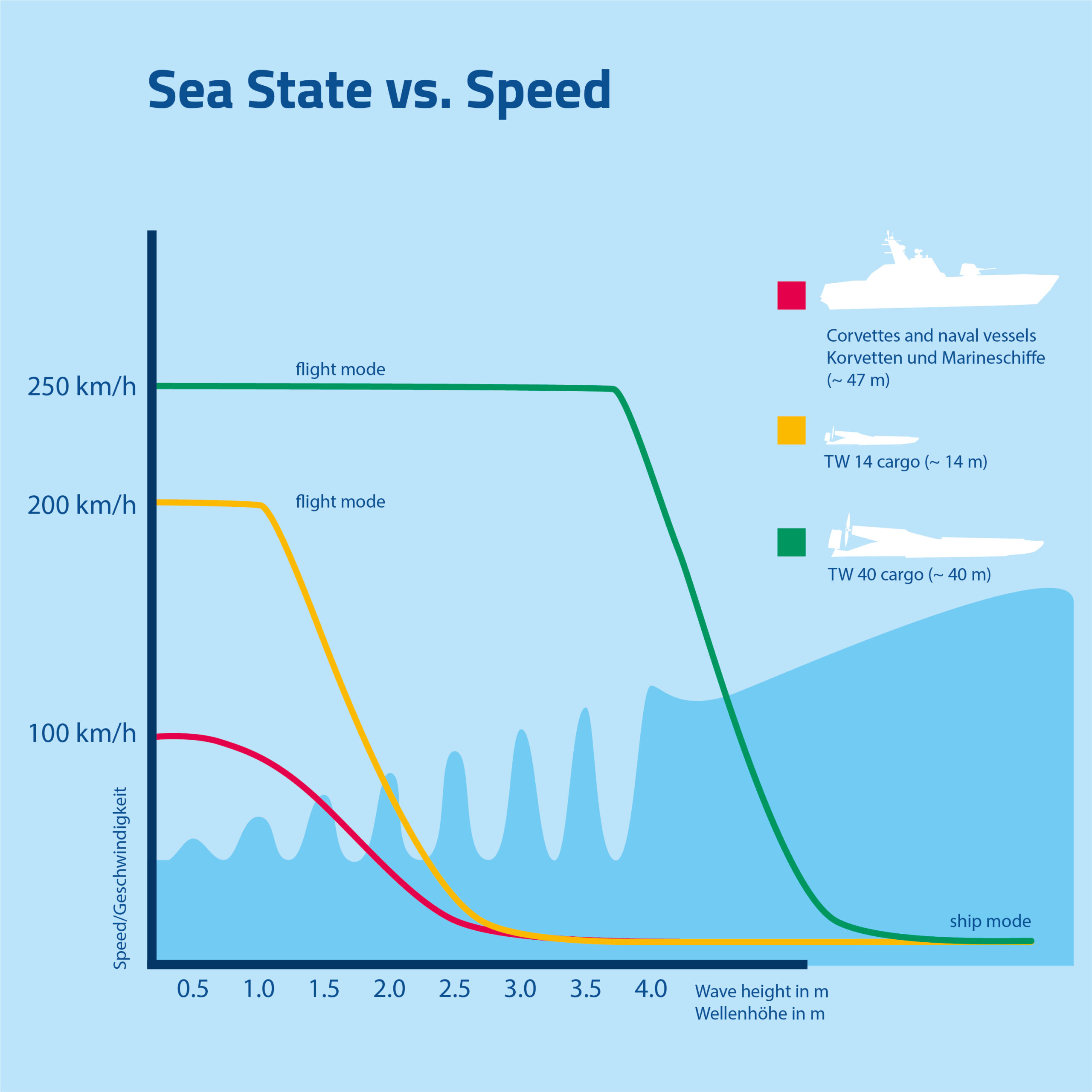
Unlike boats, ground-effect vehicles have no continuous contact with the water during flight. Their performance is therefore not primarily limited by hydrodynamic resistance, but by the available clearance above the waves.
The operational wave height depends on vehicle size and flight height:
The 4-metre platform (TW 4 cargo) can maintain full speed in waves up to approximately 0.4 metres.
The 14-metre platform (TW 14 cargo) is being designed for high-speed operation in significantly higher sea states, i.e. approximately 1.30 metres.
If wave conditions exceed the ground-effect operating limits of a particular vehicle size, the craft can transition to ship mode and continue as a conventional watercraft at an appropriate speed.
Larger vehicles fly higher and therefore offer greater wave tolerance.
Take-off, landing and safe clearance remain dependent on local conditions. The precise operating envelope of each vehicle size will be established through testing.
TandAIRium vehicles do not replace ships or aircraft. They add speed and reach in conditions where conventional surface vessels may already need to slow down.
How are TandAIRium vehicles classified? What licence is required?
TandAIRium passenger vehicles are designed for certification as Type A WIG craft. This means they operate exclusively within ground effect and fall under the maritime rather than the aviation regulatory regime.
They can therefore be operated with the appropriate boat licence instead of a pilot’s licence. The precise qualification requirements depend on national regulations, vehicle size and commercial use.
Learn more about WIG craft classification at the International Maritime Organization (IMO)
Do TandAIRium vehicles require special infrastructure?
No. TandAIRium vehicles use existing maritime infrastructure.
Within ports and harbours, they operate in ship mode like conventional watercraft and can use standard waterways, harbour entrances and suitable berths. Outside the harbour area, they transition into ground-effect operation.
No dedicated launch system, specialised terminal or WIG-specific infrastructure is required.
Our Team
Small Core. Deep Expertise. One Shared Ambition.
TandAIRium is a small deep-tech startup united by a passion for ground-effect vehicles based on Günther W. Jörg’s tandem-airfoil principle.
Our story leads from the original invention through hand-built and successfully flown prototypes to today’s scalable vehicle platform. Our core team combines technology, business and communication, supported by a trusted network of specialists, manufacturers and suppliers.
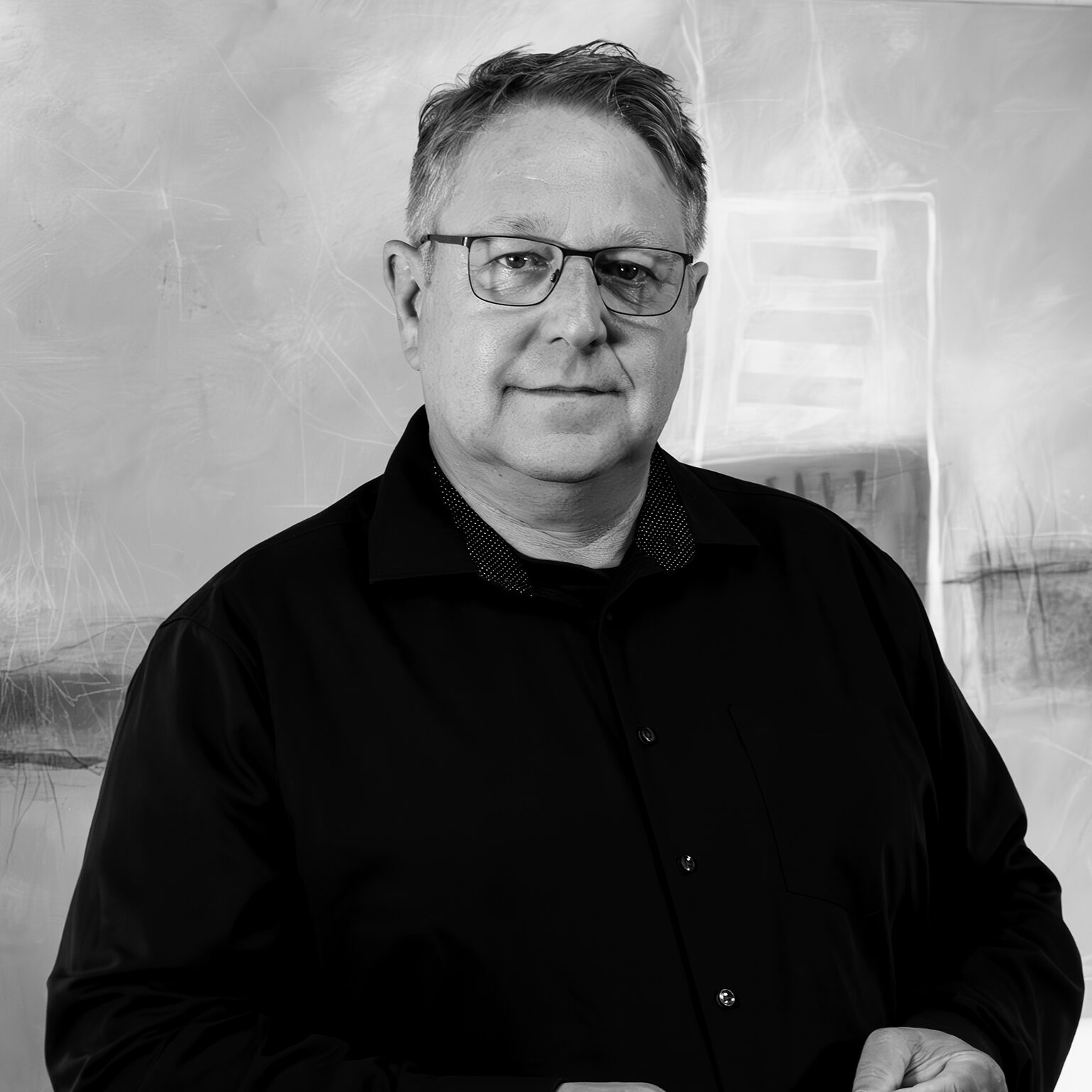
Dipl.-Ing. Reiner A. Jörg
CEO/CTO and Co-Founder
Ground-Effect Expert · Lead Developer of all TandAIRium Vehicle Concepts

Dipl.-Ing. Sebastian Hilberg
Business Development
Market Strategy · Positioning · Commercial Development

Dipl.-Des. Kerstin Heinlein
Communication and Design
Visual Identity · Content Strategy · Customer Engagement
Contact us
We’d love to hear from you. Whether you’re looking for more information, a detailed presentation, or would like to schedule a live demonstration of the TW4 cargo, our team is here to connect.
Let’s explore how ground effect technology can shape the future — together.
Reach out to start the conversation, exchange ideas, or arrange a meeting.